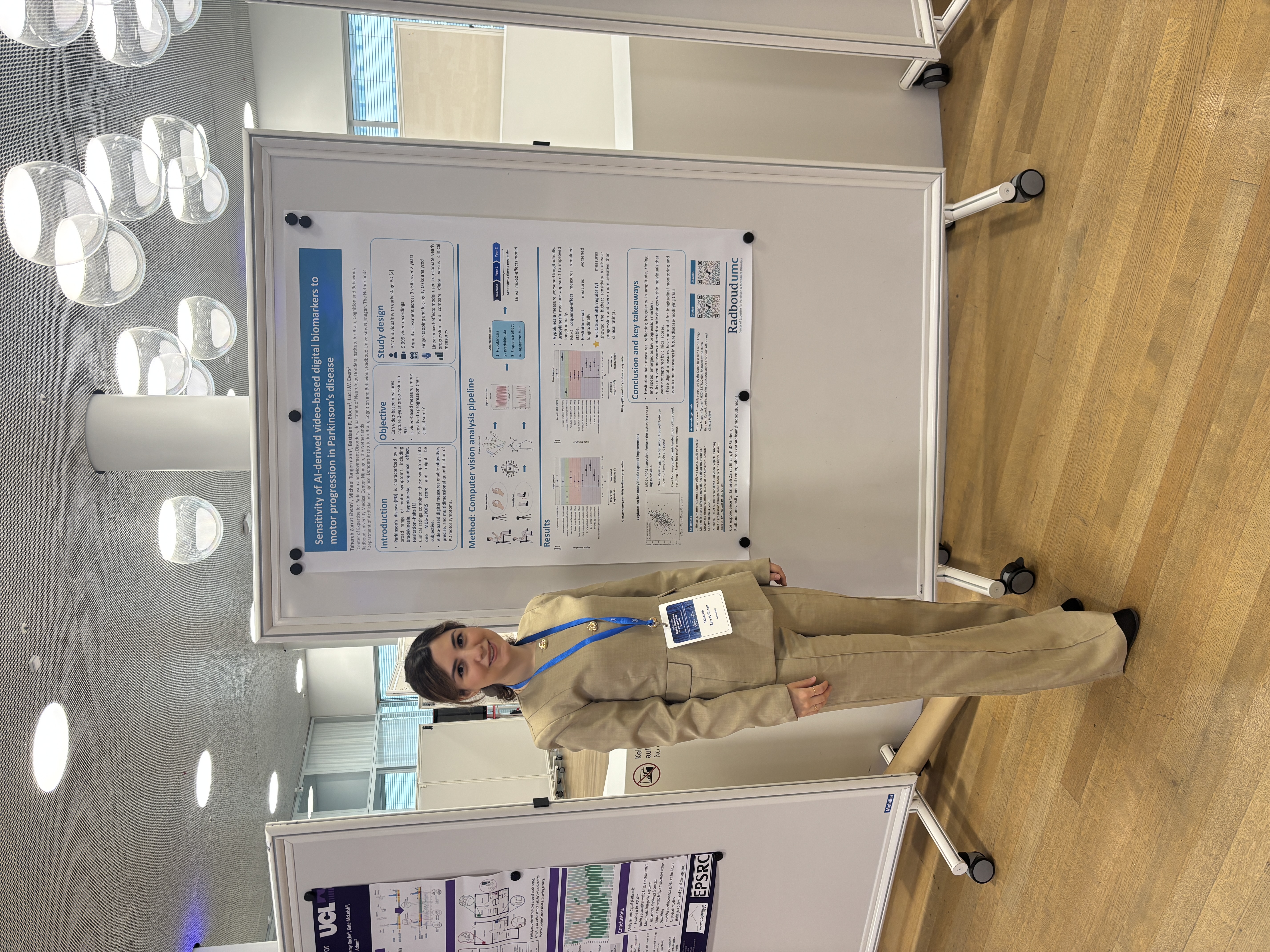
Presenting my poster at Digital Biomarkers in Clinical Trials Summit
I am very happy to share that I recently presented my poster at the Digital Biomarkers in Clinical Trials Summit in Basel.
My research focuses on using AI to develop video-based digital biomarkers for quantifying motor symptoms in Parkinson’s disease. In our work, we analyze video recordings of MDS-UPDRS motor tasks and extract objective features related to movement amplitude, speed, rhythm, sequence effect, and hesitation.
What makes this work especially exciting to me is its potential impact. We observed that these video-derived measures are sensitive to subtle motor changes over time, highlighting their potential for longitudinal monitoring and for supporting outcome measures in clinical trials.
At the summit, I noticed that much of the discussion around digital biomarkers still focuses on sensors, wearables, and clinical assessments. These are extremely valuable, but I believe video can also play an important role. Video recordings can be relatively low-cost, accessible, and comfortable for patients, while still providing rich information about motor performance.
One moment that really stayed with me was when someone from a pharmaceutical company discussed my poster with their team and said that they should also consider adding video to their work. Hearing that was very encouraging and reminded me why I am enthusiastic about this research.
Presenting this work at the summit was a meaningful experience. I had the chance to discuss my research with people from the clinical trial and digital biomarker community, hear different perspectives, and reflect on how this work could contribute to more accessible and objective assessment of Parkinson’s disease.
I am deeply grateful to my supervisors for their continuous guidance and support, and especially to the study participants, whose contributions make this research possible.
This experience left me even more motivated to continue working on digital biomarkers and AI-based tools that may help improve how we monitor disease progression and treatment response in Parkinson’s disease.